PUBLISHED · CAIN INDUSTRIES · RE-MODELLED
CHR — condensing heat recovery (CXL / DXL)

Regional Hospital, United States: three FCR-1L3816ALS units on 300 HP steam boilers

A published installation by Cain Industries — duty, temperatures and flows are theirs. We re-ran the published inputs through the PULSE method to get the number a case study usually leaves out: how much of the fuel bill it actually is, in US, Vietnamese and metric units.

01 · Plant profile

Plant profile

CustomerRegional Hospital · Wisconsin, United States
ApplicationHospital · steam boiler house · retrofit of an existing installation
Boilers3 × 300 HP steam boilers · 223.8 kW each · 2.28 t/h each · 671 kW installed
Steam condition6.5 bar(g) · 94.3 psig · saturated steam 168.0 °C / 334.4 °F
Recovery equipmentFCR-1L3816ALS × 3 — CHR, condensing heat recovery only, no condensing stage
Flue gas425 → 302 °F at 4,184 SCFM
Heat sink22 GPM, +39 °F rise — boiler feedwater
Recovered duty (published)408,000 BTU/h
SourceCain Industries — published case study
02 · Baseline — before recovery

Baseline — before recovery

The hospital’s boilers ran with no heat recovery on the flue: gas left the boiler at 425 °F and went to the stack, so 100 % of the fuel bill was spent to put steam into the hospital and part of that fuel went up the chimney as heat above the water dew point.

The baseline is the published one — flue gas at 425 °F, 4,184 SCFM, feedwater entering the recovery unit at 22 GPM and leaving 39 °F warmer. Those are Cain’s design figures for this installation, not our measurement, and we have not altered them.

What the boundary contains

One boiler house: three steam boilers, their common flue path, and the feedwater loop the recovery unit heats. Fuel in, steam out, flue temperatures in and out of the unit, water in and out.

03 · Solution — what was installed

Solution — what was installed

Three FCR-1L3816ALS heat-recovery units were installed, one per 300 HP steam boiler, each taking heat above the water dew point out of the flue gas and putting it into boiler feedwater. Flue gas leaves the boiler at 425 °F and leaves the recovery unit at 302 °F at 4,184 SCFM; the water side runs 22 GPM with a 39 °F rise.

This is a condensing installation. The sink available on site never goes below the flue’s water dew point, so no latent heat is recovered and nothing condenses — and therefore no water saving is claimed anywhere on this page.

Equipment

FCR-1L3816ALS, three units, one per boiler. Condensing heat recovery from the flue gas into feedwater.

Why not condensing

The existing sink runs at 227 °F, far above the 131 °F dew point of the flue gas. A condensing stage on that sink would recover nothing, so the installation stays as built.

Three units, one per boiler

The published case gives one total duty for the installation, not a figure per unit. The table below splits that total equally across the three units — equal-share arithmetic on Cain’s published 408,000 BTU/h, not a separate per-unit measurement. The boiler ratings are Cain’s.

UnitBoiler servedModelShare of published duty
FCR-01300 HP steam boiler · 2.28 t/h · 223.8 kWFCR-1L3816ALS136,000 BTU/h · 39.9 kW
FCR-02300 HP steam boiler · 2.28 t/h · 223.8 kWFCR-1L3816ALS136,000 BTU/h · 39.9 kW
FCR-03300 HP steam boiler · 2.28 t/h · 223.8 kWFCR-1L3816ALS136,000 BTU/h · 39.9 kW
Total3 × 300 HP · 671 kW installed—408,000 BTU/h · 119.6 kW · 0.41 MMBtu/h

Installed cost in the published case is $19,234 for the three units together, which is what the 9.4-month payback is computed on. No per-unit cost is published, so none is shown.

04 · Live process values

Live process values

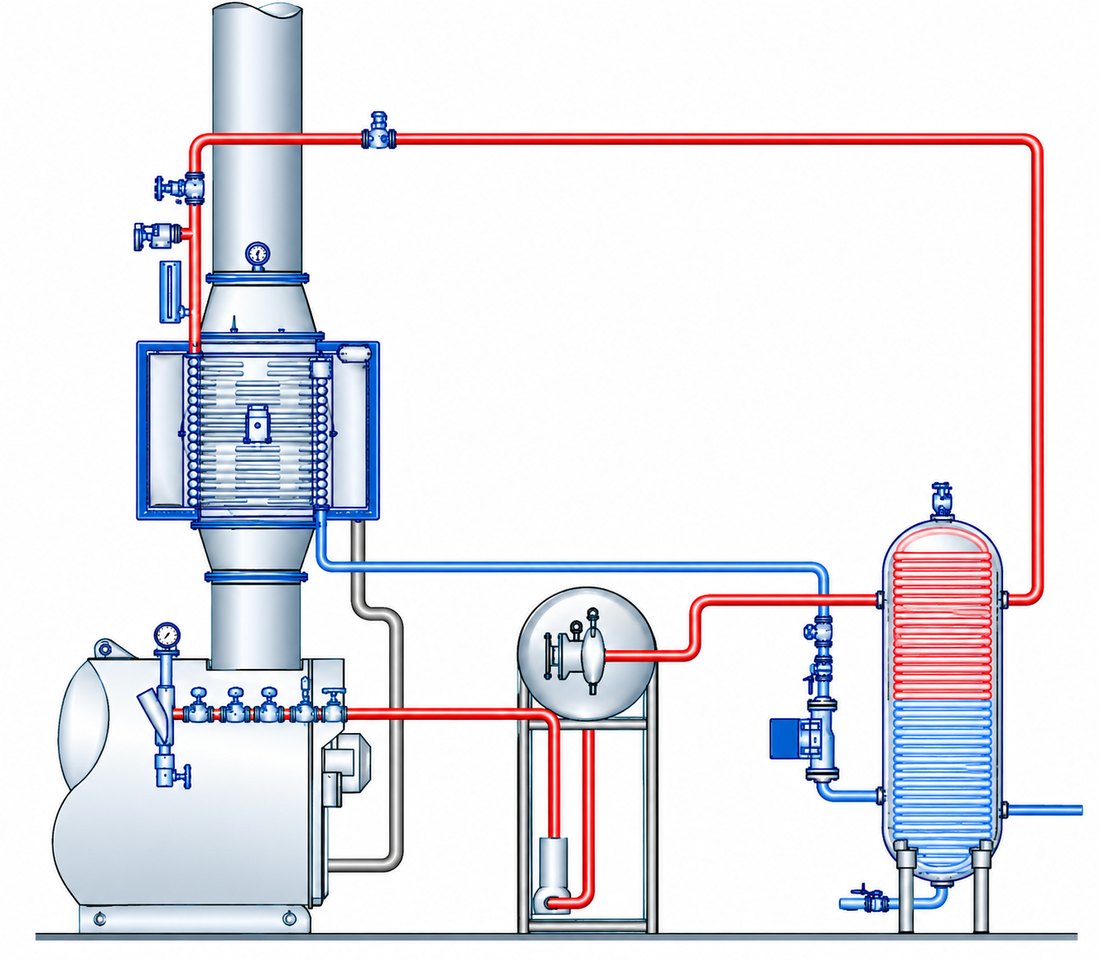
Seven points on the measurement loop are instrumented: four temperatures — flue gas in, flue gas out, water in on the cold make-up line and water out on the heated feedwater line — plus steam pressure at the boiler, circulating water flow and condensate flow. The four temperatures are the points a real installation needs in order to prove recovery on both the flue side and the water side; the three flows are what shows the unit is actually working rather than merely warm. They are placed on the vendor’s general above-dew-point-heat application P&ID: the catalogue carries no drawing specific to this unit’s model, so the general arrangement is used and no model-specific claim is made.

The readings below are the PULSE demo plant for Regional Hospital — a simulated model of a condensing economizer, refreshed every five seconds from the PULSE data service. They demonstrate the measurement points and the trend; they are not the measured installation reported in the sections above. Circulating water flow and condensate flow have no field instrument in the model — they are derived from the live temperatures and the flue moisture, and the feed publishes them as modelled values. Condensate flow reads zero because the flue leaves far above its dew point: a condensing unit condenses no water, so the zero is physics rather than a missing reading.
Demo plant · simulated sensor data—
Cain Industries general-application P&ID: preheating boiler feedwater from a steam-boiler exhaust with a single single-pass economizer and no condensing stage — the HR (condensing) arrangement installed here. Flue gas rises from the boiler through the exchanger to the stack (gas flow), feedwater leaves the exchanger heated on the red line towards the boiler, cold makeup water enters from the de-aerator side; steam header, modulating feedwater valve, condensate drain and boiler feed pump are drawn. Seven process values are live.
—°C
—°C
—°C
—°C
—bar
—kg/h
—m³/h
05 · Measured results

Measured results

The duty and temperatures below are Cain Industries’ published design data for their own installation. We have not re-measured them; what we changed is the arithmetic, expressed here in three unit systems so the same plant cannot be quoted two different ways.

3.25 %of the fuel bill saved — dry stage only
0.41 MMBtu/hrecovered duty, published (408,000 BTU/h)
$24,480fuel saving per year, modelled
9.4 monthspayback, on a $19,234 installed cost
Published duty, re-expressed in three unit systems · one set of readings, no conversion mistakes
QuantityUnited StatesVietnamOther (metric)
Recovered duty408,000 BTU/h · 0.41 MMBtu/h120 kW · 957 MWh/yr120 kW · 957 MWh/yr
Flue gas temperature425 → 302 °F218.3 → 150.0 °C218.3 → 150.0 °C
Annual fuel (as saved)40,800 therm4,304 GJ · 957 MWh3,444 GJ
Annual saving$24,480643,824,000 VND€22,522 · £19,339
CO₂ avoided238.4 short tons216.2 tonnes216.2 t
Recovered duty408,000 BTU/h120 kW120 kW

How to read the three columns

The three columns hold one set of readings, converted. Nothing is re-measured between them: 425 → 302 °F is the publisher’s figure and 218.3 → 150.0 °C is the same figure converted. Where two columns repeat a value it is because the unit is the same, not because a second calculation produced it.

What is measured, and by whom

Nothing here is measured by us. Cain Industries published the flue temperatures, the 4,184 SCFM and the 408,000 BTU/h for their own installation, and those are the inputs to every number on this page. Our contribution is the model that turns them into a percentage of the fuel bill and a payback in months.

What the same duty is worth elsewhere

408,000 BTU/h is 119.6 kW of recovered heat. Run for 8,000 hours it is 957 MWh a year, which is what the metric column reports. At the published $0.60/therm that is $24,480; a hospital paying a different gas price moves the money, not the percentage.

06 · Savings and payback

Savings and payback

The arithmetic is short enough to redo by hand. A boiler putting out 10,042 MBH at 80 % efficiency burns 12,553,125 BTU/h of fuel. The recovery unit takes 408,000 BTU/h back out of the flue, so the saving is 408,000 / 12,553,125 = 3.25 % of the fuel bill — the first number every case on this site reports.

At 8,000 running hours a year that is 40,800 therm of gas, and at $0.60/therm it is $24,480 a year. Cain publish a saving of $14,231/yr for the same installation, which implies roughly 4,651 running hours a year at that gas price; the difference between the two figures is run-hours, not efficiency. On an installed cost of $19,234 the modelled payback is 9.4 months.

What the condensing case would add, and why it is not claimed here

With a cold sink — make-up water at about 80 °F — the same flue gas could be taken below its 131 °F dew point. The flue holds a further 1,810,595 BTU/h (14.42 % of fuel) below that point, but the sink could only absorb 440,000 BTU/h (3.51 % of fuel) at 22 GPM, and taking it all would need 91 GPM. Combined, the two-stage logic would reach 3.25 % + 3.51 % = 6.76 % of fuel. Those numbers are modelled from published design data, not metered, and the installation as built is the 3.25 % case.

07 · Verification method

Verification method

This is a manufacturer-published installation, not a site we instrumented. The duty, temperatures, flows and the published payback are Cain Industries’ design figures for their own customer. What we did was re-run those inputs through the PULSE model and state every assumption so the arithmetic can be checked.

The same inputs are also seeded as a modelled site inside PULSE (p_cain_ocono), where the application’s own efficiency calculation returns 3.48 % on the first boiler. The number on this page is reproducible in the product, not just in a spreadsheet.

On a real project the published design duty is replaced by meters: fuel, gas temperature before and after the unit, water in and out, and — where a condensing stage exists — condensate mass flow. That is what turns a design figure into a re-derivable saving under the M&V protocol.

What this page does not claim

It does not claim a measurement we made: there is no fuel meter, no flue-gas analyser and no water meter of ours on this site. It does not claim a condensing saving, because the installation is condensing. It does not claim a whole-plant saving either — the boundary is the boiler house, and 3.25 % of the fuel those three boilers burn is not 3.25 % of the hospital’s gas bill if the boilers are only part of it.

What a metered version would add

Three readings per unit turn this from a design figure into a measured one: fuel flow at the burner, flue temperature before and after the recovery unit, and feedwater flow with its inlet and outlet temperature. Those five signals per boiler, sampled once a minute, are enough to re-derive the duty without trusting any summary table — and they are what the modelled p_cain_ocono site in PULSE already records.

08 · Before and after

Before and after

Before
425 °F
flue gas straight to the stackfuel bill 100 %
→
After
302 °F
3.25 % less fuel$24,480 a year
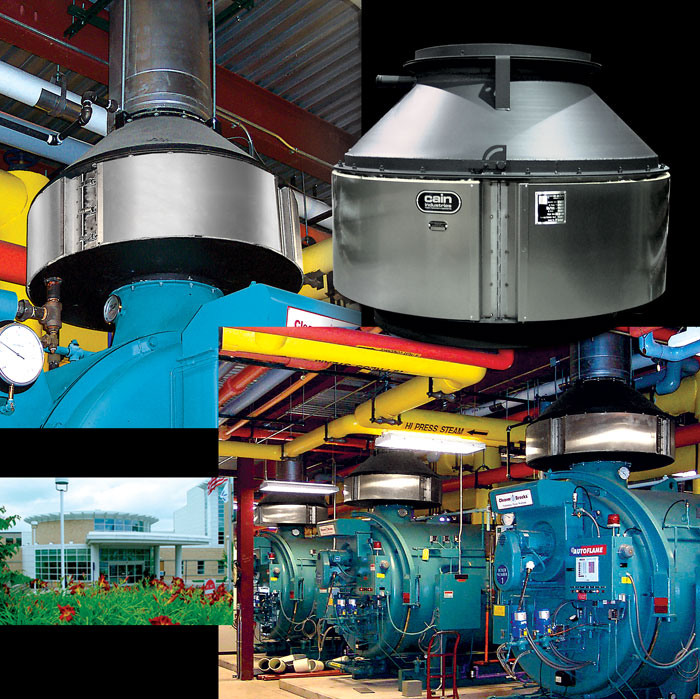
After the retrofit: Cain heat-recovery units installed above the flue of the packaged steam boilers in the hospital boiler house (before, flue gas went straight to the stack)
Cain heat-recovery units over the flue of the packaged boilers — the installation this page re-models, as published by the manufacturer.Photo: Cain Industries
09 · Download, sources and what this document is

Download, sources and what this document is

What this document is. A published installation by Cain Industries, re-modelled by Vegax Energy. The customer is Cain’s customer, not ours, and the plant is not instrumented by us. Design data is theirs; the percentages, the money and the condensing case are our model, stated with their assumptions so anyone can redo the arithmetic.