PUBLISHED · CAIN INDUSTRIES · RE-MODELLED
CHR — condensing heat recovery (CXL / DXL)

University Campus, United States: three EM-28 units on 4.64 t/h steam boilers

A published installation by Cain Industries — duty, temperatures and flows are theirs. We re-ran the published inputs through the PULSE method to get the number a case study usually leaves out: how much of the fuel bill it actually is, in US, Vietnamese and metric units.

01 · Plant profile

Plant profile

CustomerUniversity Campus · California, United States
ApplicationUniversity central plant · steam boilers · retrofit of an existing installation
Boilers3 × EM-28 · 4,021 HP (3,000 kW) each · 4.64 t/h each · 9,000 kW installed
Steam condition7 bar(g) · 101.5 psig · saturated steam 170.4 °C / 338.7 °F · 4.64 t/h
Recovery equipmentEM-28 × 3 — CHR, condensing heat recovery only, no condensing stage
Flue gas490 → 300 °F at 1,750 SCFM
Heat sink30 GPM, +26 °F rise — boiler feedwater
Recovered duty (published)400,000 BTU/h
SourceCain Industries — published case study
02 · Baseline — before recovery

Baseline — before recovery

The campus central plant ran its boilers with no heat recovery on the flue: gas left at 490 °F and went to the stack. Every hour of operation spent fuel to make steam, and part of that fuel went out of the chimney as heat above the water dew point.

The baseline is the published design point — flue gas at 490 °F, 1,750 SCFM, feedwater entering the recovery unit at 30 GPM and leaving 26 °F warmer. Those figures are Cain’s for this installation and we have not altered them.

What the boundary contains

One central plant: three steam boilers and their common flue path, plus the feedwater loop the recovery unit heats. Fuel in, steam out, flue temperatures in and out of the unit, water in and out.

03 · Solution — what was installed

Solution — what was installed

Three EM-28 heat-recovery units were installed, one per boiler, each taking heat above the water dew point out of the flue gas and putting it into boiler feedwater. Flue gas leaves the boiler at 490 °F and leaves the recovery unit at 300 °F at 1,750 SCFM; the water side runs 30 GPM with a 26 °F rise.

As with the hospital case, this is condensing. The existing sink runs at 160 °F, far above the 131 °F dew point of the flue gas, so a condensing stage on that sink would recover nothing and no condensate or water saving is claimed.

Equipment

EM-28, three units, one per 4,021 HP boiler. Condensing heat recovery from the flue gas into feedwater.

Why not condensing

The sink at 160 °F cannot take the flue below its dew point. On a new build the second stage would need a cold sink — make-up water at about 80 °F — and that is a water-side decision, not an economizer decision.

04 · Live process values

Live process values

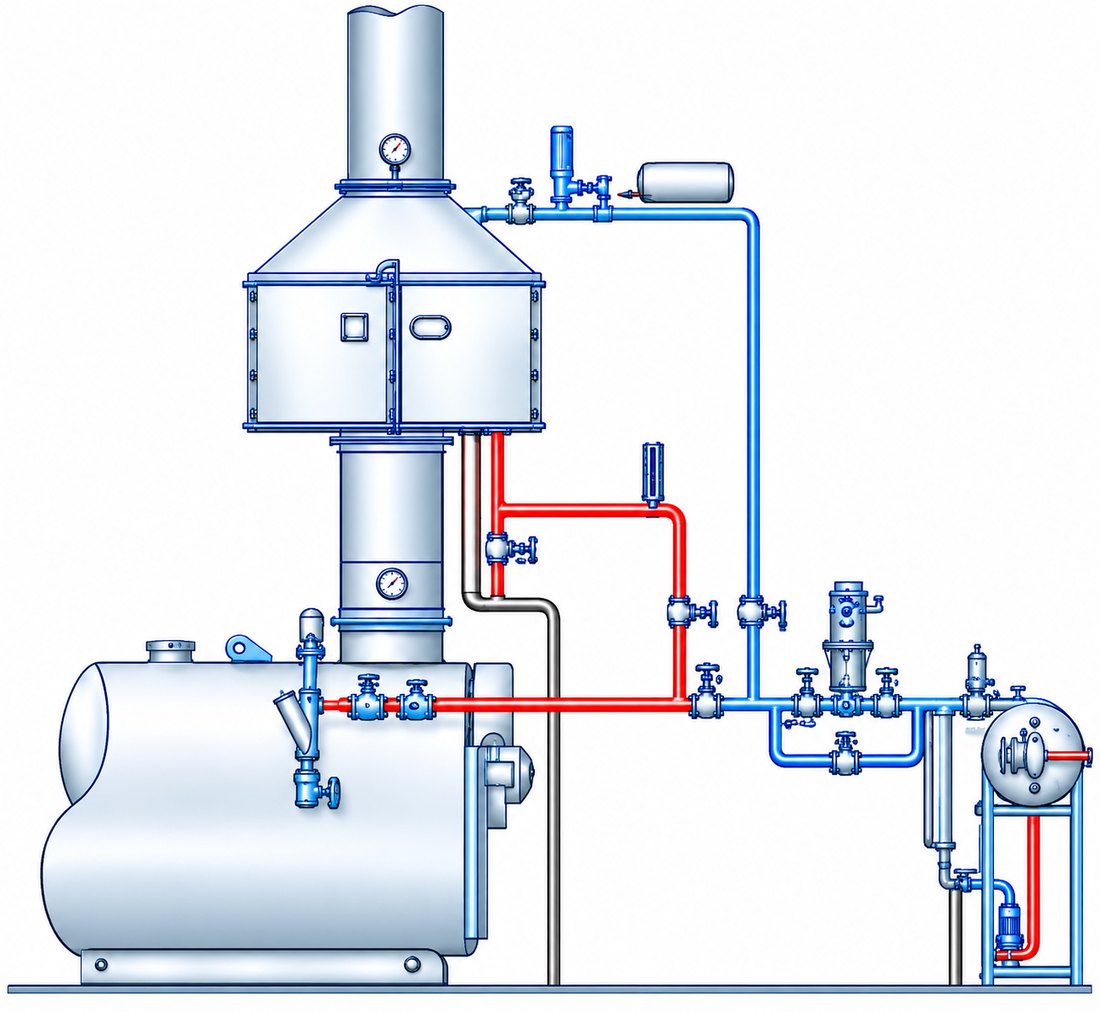
Seven points on the above-dew-point loop are instrumented: four temperatures — flue gas in, flue gas out, water in on the cold make-up line and water out on the heated feedwater line — plus steam pressure at the boiler, circulating water flow and condensate flow. The four temperatures are the points a real installation needs in order to prove recovery on both the flue side and the water side; the three flows are what shows the unit is actually working rather than merely warm. They are placed on the vendor’s general above-dew-point-heat application P&ID: the catalogue carries no drawing specific to this unit’s model, so the general arrangement is used and no model-specific claim is made.

The readings below are the PULSE demo plant for University Campus — a simulated model of a condensing economizer, refreshed every five seconds from the PULSE data service. They demonstrate the measurement points and the trend; they are not the measured installation reported in the sections above. Circulating water flow and condensate flow have no field instrument in the model — they are derived from the live temperatures and the flue moisture, and the feed publishes them as modelled values. Condensate flow reads zero because the flue leaves far above its dew point: a condensing unit condenses no water, so the zero is physics rather than a missing reading.
Demo plant · simulated sensor data—
Cain Industries general-application P&ID: preheating boiler feedwater from a steam-boiler exhaust with a single single-pass economizer and no condensing stage — the general above-dew-point-heat application installed here. Flue gas rises from the boiler through the exchanger to the stack, heated feedwater leaves on the red line, cold makeup water enters from the de-aerator side; steam header, modulating feedwater valve, condensate drain and boiler feed pump are drawn. Seven process values are live.
—°C
—°C
—°C
—°C
—bar
—kg/h
—m³/h
05 · Measured results

Measured results

The duty and temperatures below are Cain Industries’ published design data for their own installation. We have not re-measured them; what we changed is the arithmetic, expressed here in three unit systems so the same plant cannot be quoted two different ways.

3.13 %of the fuel bill saved — dry stage only
0.40 MMBtu/hrecovered duty, published (400,000 BTU/h)
$21,000fuel saving per year, modelled
5.7 monthspayback, on a $9,962 installed cost
Published duty, re-expressed in three unit systems · one set of readings, no conversion mistakes
QuantityUnited StatesVietnamOther (metric)
Recovered duty400,000 BTU/h · 0.40 MMBtu/h117 kW · 703 MWh/yr117 kW · 703 MWh/yr
Flue gas temperature490 → 300 °F254.4 → 148.9 °C254.4 → 148.9 °C
Annual fuel (as saved)30,000 therm3,165 GJ · 703 MWh2,532 GJ
Annual saving$21,000552,300,000 VND€19,320 · £16,590
CO₂ avoided175.3 short tons159.0 tonnes159.0 t
Recovered duty400,000 BTU/h117 kW117 kW
06 · Savings and payback

Savings and payback

A boiler putting out 10,236 MBH at 80 % efficiency burns 12,795,525 BTU/h of fuel. The recovery unit takes 400,000 BTU/h back out of the flue, so the saving is 400,000 / 12,795,525 = 3.13 % of the fuel bill.

At 6,000 running hours a year that is 30,000 therm, and at $0.70/therm it is $21,000 a year. Cain publish a saving of $13,924/yr for the same installation, which implies about 3,978 running hours a year at that gas price; again the difference is run-hours, not efficiency. On an installed cost of $9,962 the modelled payback is 5.7 months.

What the condensing case would add, and why it is not claimed here

Adding a cold sink (make-up water at about 80 °F) would let the flue be taken below its 131 °F dew point. The flue holds 1,596,382 BTU/h (12.48 % of fuel) below that point, the sink could absorb 600,000 BTU/h (4.69 % of fuel) at 30 GPM with a 40 °F rise, and taking it all would need 80 GPM. Combined, the two-stage logic would reach 3.13 % + 4.69 % = 7.82 % of fuel — the same pattern our own demo plant reports as 5.92 % + 2.55 % (decomposition of the measured 8.47 %). Those numbers are modelled from published design data, not metered.

07 · Verification method

Verification method

This is a manufacturer-published installation, not a site we instrumented. Duty, temperatures, flows and the published payback are Cain Industries’ figures for their own customer; we re-ran the inputs through the PULSE model and state every assumption so the arithmetic can be checked.

The same inputs are seeded as a modelled site in PULSE (p_cain_csulb), where the application’s own efficiency calculation returns 5.32 % on the first boiler — the number on this page is reproducible in the product, not just in a spreadsheet.

On a real project the design duty is replaced by meters: fuel, gas temperature before and after the unit, water in and out, and condensate mass flow where a condensing stage exists. That is what turns a design figure into a re-derivable saving under the M&V protocol.

08 · Before and after

Before and after

Before
490 °F
flue gas straight to the stackfuel bill 100 %
→
After
300 °F
3.13 % less fuel$21,000 a year
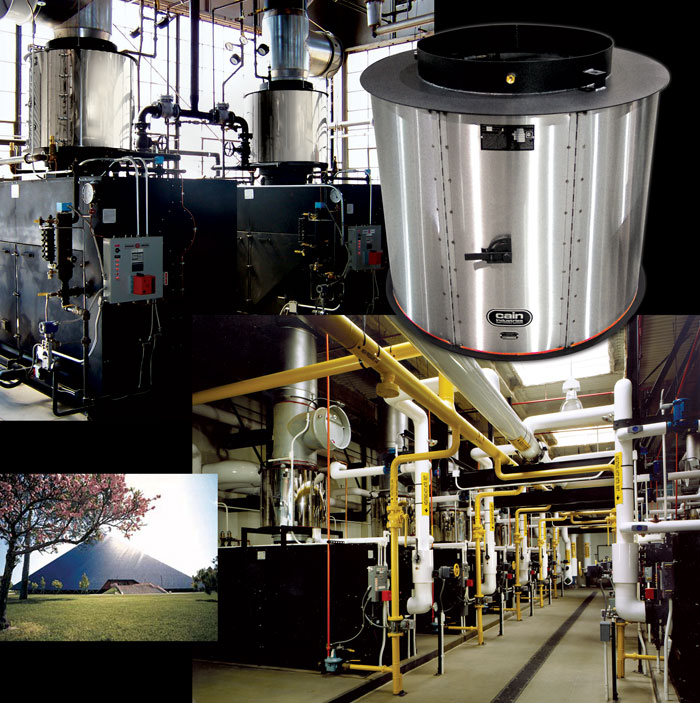
After the retrofit: Cain EM-series heat-recovery units over the packaged steam boilers in the university central plant (before, flue gas went straight to the stack)
Cain heat-recovery units on the boiler flue — the installation this page re-models, as published by the manufacturer.Photo: Cain Industries
09 · Download, sources and what this document is

Download, sources and what this document is

What this document is. A published installation by Cain Industries, re-modelled by Vegax Energy. The customer is Cain’s customer, not ours, and the plant is not instrumented by us. Design data is theirs; the percentages, the money and the condensing case are our model, stated with their assumptions so anyone can redo the arithmetic.