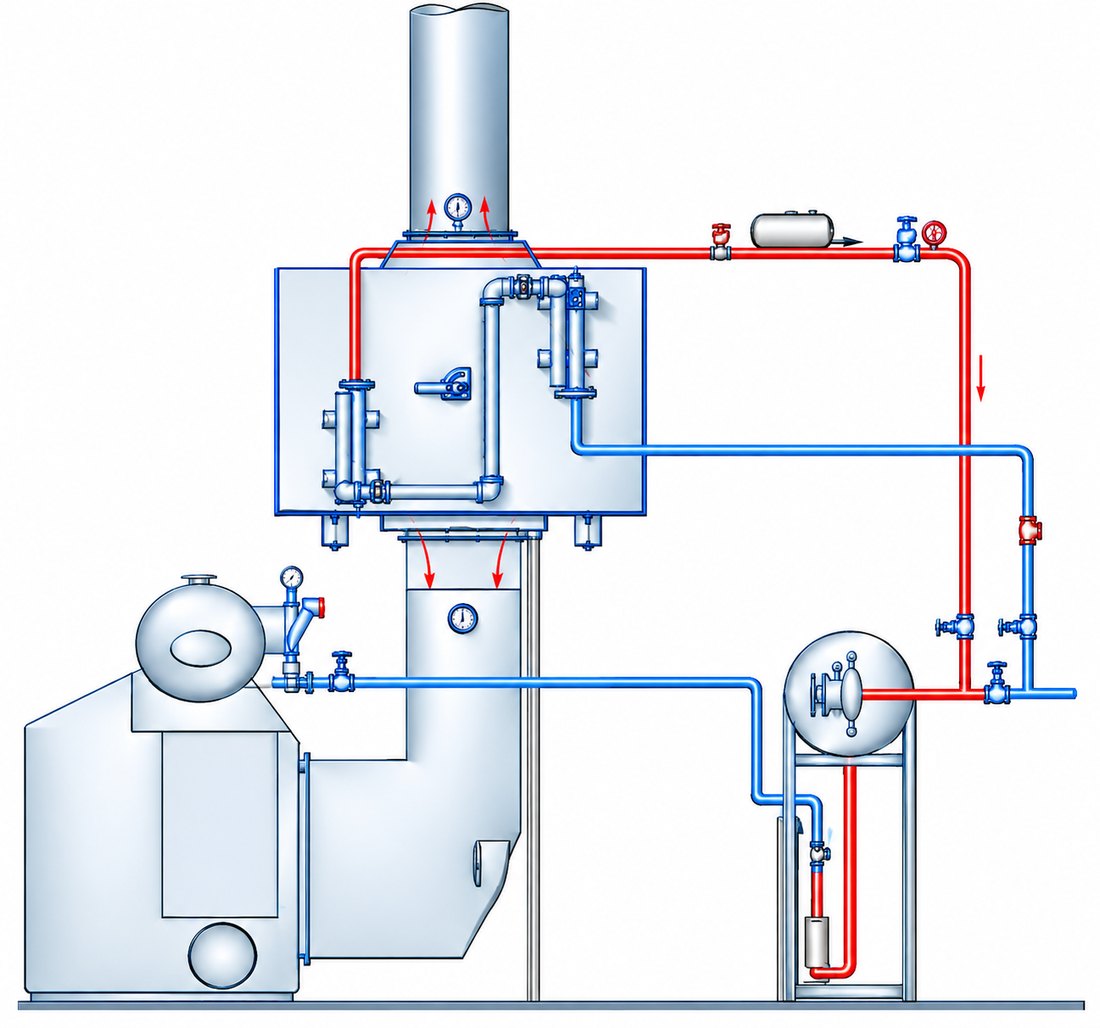
Four gas-fired steam boilers, flue gas leaving at 187 °C, and a fuel meter that settles the argument. We instrumented the plant, ran the baseline, then added a single-pass condensing recovery unit — heat above the water dew point first, latent heat in the same pass — and published the meters. This is our own reference installation, so the numbers are measured, not modelled.
| Customer | Avis Foods · Vietnam (demo tenant, plant code withheld) |
|---|---|
| Application | Food processing · 4 gas-fired steam boilers · single-pass condensing flue-gas recovery |
| Boilers | SB-01 2,000 kW · SB-02 3,000 kW · SB-03 4,000 kW · SB-04 6,000 kW — 15,000 kW installed |
| Recovery equipment | CHR (above-dew-point) + CHR (condensing) + VX-MV metering, CXL single-pass condensing family |
| Flue gas path | 187 °C at the boiler outlet → 110 °C after the dry stage → 45 °C after condensing |
| Heat sink | Boiler feedwater and process make-up water, cold enough to take the flue below its dew point |
| Measurement | Fuel, steam, flue in/out, water in/out, condensate — 1-minute samples |
| Data | Public dashboard · M&V protocol (IPMVP option B) |
Before recovery the flue left the boiler house at 187 °C and went straight to the stack. Nothing was wrong with the plant: the boilers were tuned, the steam load was steady, and the fuel bill was simply what it was. That is the point of a baseline — it is the number the recovery has to beat.
We ran the plant on the existing configuration with the meters live for a full baseline period, so the before-state is a measured record rather than a nameplate assumption. Fuel input, steam output, flue temperature in and out, water in and out, condensate were all sampled once a minute and stored before any recovery equipment was commissioned.
Recovery went in as one pass on the flue path. The CHR unit is a single-pass condensing exchanger: the flue gas crosses one bank of tubes and gives up heat above the water dew point to the feedwater on the way in, from 187 °C down to about 110 °C, then drops below its water dew point inside the same pass, where the latent heat of the flue moisture is released and the water itself condenses out, leaving the unit at 45 °C. VX-MV meters the whole boundary: fuel, steam, flue temperatures, water in and out, condensate mass flow.
One pass rather than two is enough here only because the plant has a sink cold enough to take the latent heat — condensing needs a return temperature below the dew point, not just a bigger box on the flue.
Flue gas 187 → 110 °C, heat into boiler feedwater. Above the dew point no water condenses, so this part alone is what every economizer project already has.
Flue gas 110 → 45 °C, same pass, second half of the surface. Latent heat plus the water that condenses out of the flue, metered on the drain so the unit can be proven to be condensing rather than idling.
The readings below are the PULSE demo plant for Avis Foods — a simulated model of the Cain CXL two-stage unit, refreshed every five seconds from the PULSE data service. They demonstrate the measurement points and the trend; they are not the measured installation reported in the sections above. Circulating water flow and condensate flow have no field instrument in the model — they are derived from the live temperatures, the fuel input and the flue moisture, and the feed publishes them as modelled values.

Measured on the plant meters across the normal load profile, with the unit running and condensate proven on the drain. One set of readings, expressed in three unit systems.
| Quantity | United States | Vietnam | Other (metric) |
|---|---|---|---|
| Recovered duty | 2,818,769 BTU/h · 2.82 MMBtu/h | 826 kW · 6,609 MWh/yr | 826 kW · 6,609 MWh/yr |
| Flue gas temperature | 369 → 113 °F | 187.2 → 45.0 °C | 187.2 → 45.0 °C |
| Annual fuel (as saved) | 281,877 therm | 29,738 GJ · 6,609 MWh | 23,792 GJ |
| Annual saving | $37,819 | 994,650,341 VND | €34,794 · £29,877 |
| CO₂ avoided | 107.3 short tons | 97.3 tonnes | 97.3 t |
| Recovered duty | 2,818,769 BTU/h | 826 kW | 826 kW |
The saving is reported the way the plant bills: in VND, at the fuel price that appears on the invoice. The dollar and euro columns are conversions at a declared rate (1 USD = 26,300 VND), not a second measurement.
The split inside the pass matters more than the total. 4.07 % of it comes from the above-dew-point part, which is what a conventional economizer would have delivered; the extra 4.55 % exists only because the flue was taken through condensation, and the condensate meter is what proves it.
This is our own reference installation rather than a customer purchase, so there is no invoiced installed cost to quote and no payback figure on this page. Installed cost for a customer project is quoted per site after the survey — see pricing.
Fuel meter and steam meter give the efficiency before and after; flue temperatures and water flow give the recovered duty; condensate mass flow proves the latent stage is running. Everything is sampled once a minute, buffered at the gateway and published, so the percentage can be re-derived by a third party from the raw record instead of being taken from a summary table.
The boundary is IPMVP option B: one measurement boundary around the boiler house, all fuel and all steam inside it. The method is written up in the M&V protocol.

What this document is. Our own instrumented reference installation — real meters, real readings, public dashboard. It is not a customer site and no customer name appears on it.